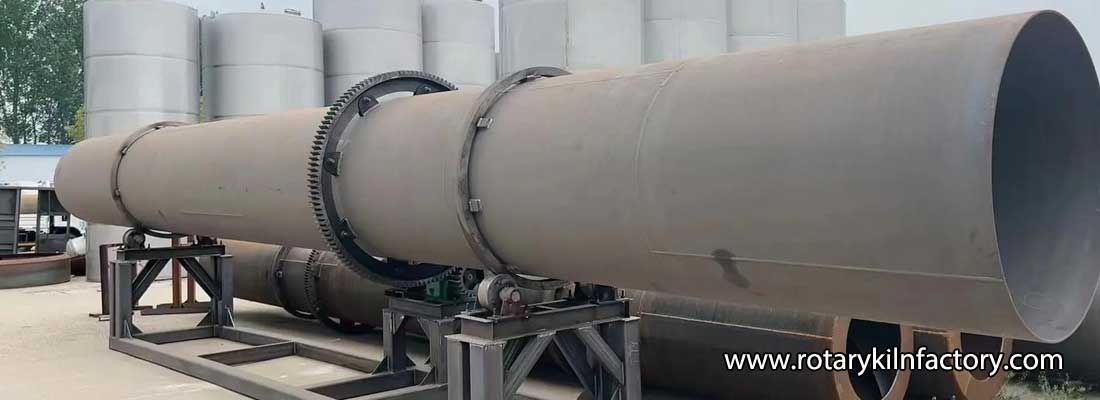

Rotary Kiln Heat Transmission Form
The main heat source in a rotary kiln is the high-temperature smoke produced by braize calcination. The heat transfers to the inner wall and materials, also the inner wall transfers heat to materials in all kinds of ways. The inner wall transmits the heat to the shell through conducting heat. The shell emission to the outer environment by convection and radiation.

cement kiln temperature 
kiln parameter control
Materials go through 4 dealing process from kiln tail to kiln head, which successively is decomposition zone, transition zone, calcination zone, and cooling zone.
Decomposition zone is around 97-60 meters from kiln head. The temperature of this zone’s materials increases slowly.
The transition zone is around 60-26 meters from the kiln head. Smoke and refractory lining ‘s temperature continually rises. The caloric receptivity of materials sharply rises. So, the temperature of materials on this zone rises.
The calcinating zone is around 26-8 meters from the kiln head. Materials have arrived at the highest temperature zone.
The cooling zone is around 8-0meters from rotary kiln head. Heat transfers from clinker to smoke, making the temperature of smoke rises and of clinker down. So cool down the clinker.
General Kiln Temperature
Rotary kiln has so many different types, so every kiln has a different fixed temperature. Let’s talk about several common rotary kilns’ temperature when calcinating.
Cement Kiln
Cement kiln is a mechanism to calcinate clinker cement. It consists of a cylinder, transmission gear, support device, kiln head, and fuel device.
When calcinating, clinker cement in virtue of rotation of cylinder to make itself sufficiently mix up and full contact. Coal Ejection Pipe calcinates and releases much heating. The heat in kiln is transferred to clinker cement by flame radiation, heat convection, and bricks transmission. Clinker cement moves forward-leaning on cylinder’s inclination and rotation of kiln. The max temperature of cement kiln can be 1600℃.
Lime Rotary Kiln
Lime rotary kiln is a professional device for processing limestone, which is mainly focused on calcinating lime. It consists of a shell, operation panel, control system, heating `parts, kiln head, kiln tail, sealing device and protective circuit.
Lime rotary kiln is different from other rotary kilns because it has a preheat bin. Before limestone even come in a rotary kiln, the temperature of the preheating bin has arrived at 1150℃. Meanwhile, limestone will be put into the preheat bin through a bucket elevator and be heated to 900℃. Then be put into the kiln to process calcinating by the hydraulic push rod. Be ejected until calcination craft is over. The temperature in the lime rotary kiln can be 1350℃.
Rotary Kiln For Ceramsite
After coal is fully calcinated, massive heat covers the whole kiln from kiln tail to kiln head. Ceramsite keeps being calcinated the whole time. Rotary kiln for ceramist’s highest temperature can be 1050℃.

cement kiln temperature monitor 
Influence Factor On Kiln Temperature
- Coal’s heat value.
- Coal’s moisture.
- Braize’s fineness.
- Combustion air volume.
Way To Control Kiln Temperature
- Control kiln temperature by adjusting the quantity of coal while feeding volume and rotation speed standstill.
- Control kiln temperature by changing feed volume.
- Control kiln temperature by adjusting the relative relationship between feed volume and quantity of fuel.
- Control kiln temperature by adjusting the rotation speed of the rotary kiln.
Detection Methods Of Rotary Kiln Temperature
- Rotary kiln head infrared colorimetric therm detector.
- Rotary kiln slip ring temperature measurement system.
- Rotary kiln infrared ray scanning.
- Computer picture processing.
- Rotary kiln tail HO content.
So, there are so many factors influence kiln temperature and also there are so many ways to control rotary kiln temperature. Learn this article and choose one way to take control of your kiln.