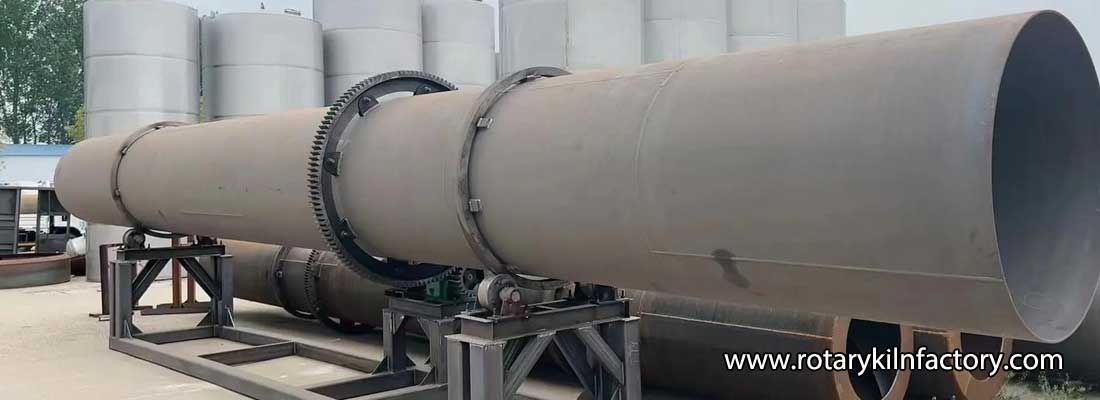

Rotary kiln shell as rotary kiln’s pillar and rotation part hold on at a high-temperature state under running. Because the rotary kiln shell has joints, which will be burned to deformation. When it gets serious, it will severely damage the regular running of the rotary kiln, if the new shell joints do not be switched in time.


The Common Reason For Kiln Shell Deformation
- Overlarge yield. Add more abrasion on shell material in the kilneye to cause the kiln shell’s overheat deformation.
- Overload heating flow. The length of the cooling zone is too short or the rotary kiln doesn’t have a cooling zone. Kilneye’s working circumstance is bad where the outlet clinker’s temperature is between 1300℃ to 1400℃ and the secondary winding is between 1000℃ to 2000℃.
- High thermal expansion. High-temperature resistance materials’ strength declines sharply.
- Bolt looseness on kilneye backplate causes fire tolerance materials to fall off to burn down the kiln shell.
- Using polluted earth. When disposed of improperly, it will cause bad corrosion to the shell and even burn down it.
- Sulphur, phosphorus, and chlorine corrosion to the kin shell. They not only decline the shell’s thickness and strength but also add steel materials’ brittleness. It may damage the kiln shell.
Want more details?
Contact us today to get more rotary kiln technical support.
Methods To Prevent Kiln Shell Deformation
Add the shell’s rigidity. Use welding to replace the rivet because the rivet shell will cause the surface too smooth to lay refractory bricks and the rivet will lose when heating. So modern rotary kiln adopts welding shell with the advantages of simple structure, lower cost, lightweight, and good strength; Increasing the thickness of the steel plate. Productive practice and theoretical analysis show that a general rotary kiln under axial bending strength has a big degree of safety but less rigidity, so it will have large radial deformation; Adopt a reinforcing ring. It was a widely used way to set several reinforcing rings on a kiln shell to enforce the rigidity of the shell.


Adopt the proper gap value of the backplate between the tyre and rotary kiln cylinder. When designing a rotary kiln, the gap value should be as small as possible. Under ideal conditions, when the rotary kiln is running, the tyre should be waling the cylinder backplate fitly, which creates no interference and no gap. The cylinder’s deformation under tyre is in accordance with the tyre, which not only has the function of strengthening radial direction rigidity, but also avoids the massive necking temperature stress. You can take the measures below: make sure your backplate is replaceable to switch regularly and hola on fitful gap; Adopt wears resistance materials as your backplate to longer the working life of the backplate; Lubricate the surface of the tyre to decline the wear out between tyre and cylinder. Adopt the grease including graphite or MOS, owing to the cylinder’s surface temperature can be 200℃ to 300℃.
Strength the tyre’s rigidity. When the gap value between tyre and the backplate is zero, the radial deformation of the cylinder can be seen as the same as tyre deformation. The cylinder’s radial deformation depends on the rigidity of tyre.