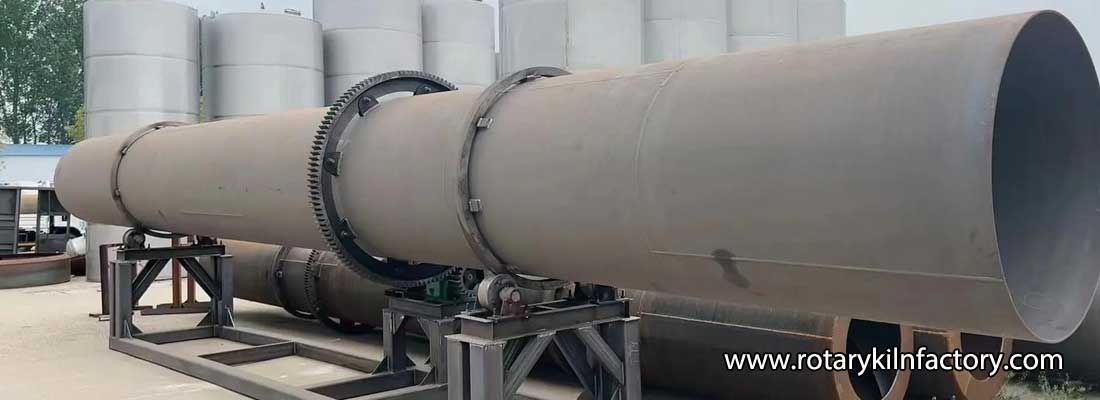

The rotary kiln and the rotary dryer share similarities, but only a few people know the differences between them. What is the gap between the concept and the entities. The rotary kiln looks similar to the rotary dryer. They all belong to drying products, but only with a little bit of differences in structure and function.

rotary kiln 
rotary dryer
Distinguished by Appearance
The rotary kiln is longer than the rotary dryer on both diameter and length. On appearance, the diameter and length are more than 10 meters while the rotary dryer’s are less than 8 meters. In general, the rotary kiln is long and thin, but the rotary dryer is stubbed.

rotary kiln shell 
rotary dryer shell
Distinguished By Temperature
The rotary kiln can bear thousands of temperature, but the rotary dryer can only handles hundreds of temperature. The highest entering air temperature should less than 800 ℃ . The working temperature is from 400 to 500 ℃ . But owing to the layer of refractory bricks in the rotary kiln. The highest temperature of rotary kiln can be 1300 ℃.
Distinguished By Structure
The rotary kiln is a horizontal-type rotating cylinder, which welds bezels with the staggered arrangement and angular difference from the bottom to the top inside the rotary dryer. Inside the rotary kiln, there are different models of refractory bricks and put spiral bezels on the feed entrance in case of leaking materials. The rotary kiln is equipped with a tire belt for baring on the outside. The cylinder bears itself on a roller device through the front tire and the latter tire, controlling the cylinder’s axial transmission by the catch wheel on the latter riding wheel. Cylinder’s rotation is formed by a gearing device through pinion driving tires outside the cylinder.
Distinguished By Function
The main requirement of rotary kiln is high temperature. Inside the cylinder laid refractory bricks, its temperature range is 800-1300℃ for high temperature requiring materials, for example, cement clinker in cement plant, iron ore magnetic roast in metallurgical industry, high alumina bauxite ore in refractory materials plant, aluminum hydroxide in aluminum manufacturer, chrome ore and chromium ore powder and sort of ores in chemical plant. Active lime kiln in iron plant, activated carbon and light – burned white stone removal in ferroalloy plant. In industry and ore sectors, calcinated materials need to be produced by rotary kiln. The rotary dryer can deal with constructive and ore productions.
Distinguished By Technology
The rotary dyer’s working technology is keeping dripping and scatting materials by cylinder’s rotation and rotary lifting board.
The rotary kiln’s function is to calcinate materials, making them sufficiently oxidated to reach brilliant chemical reaction and satisfy productive artificial requirements. It’s usually applied after classifier and magnetic separator in ore selection production line. The rotary kiln can be classified into cement kiln, lime kiln and metallurgical rotary kiln according materials; Classified into dry process and wet process according to the character of materials.