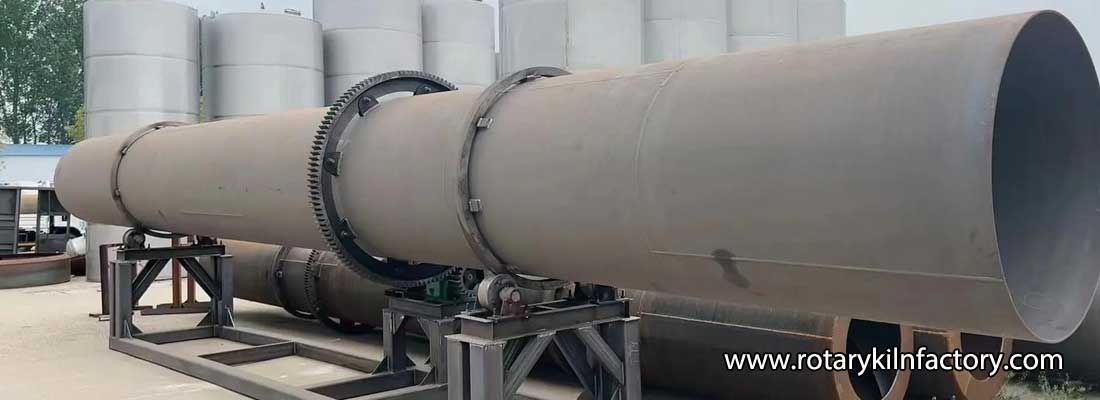

As we all know, rotary kiln is heavy industrial machinery, including cement kiln, lime rotary kiln, shaft kiln, and so on. It generally weighs 200t including barrel weight and lining weight. So, what kind of drive can actuate a heavy rotary kiln? Would it be a steam engine, electric engine, or hydraulic engine? The answers will be revealed one by one in the bellow text.
Rotary Kiln Drive Type


Actually, a rotary kiln uses a mechanical drive. Rotary kiln is a slowly rotating device, mainly composed of a motor, a deceleration case, and big and small cones. Big cone normally is split into two parts cause of its large size and fixed into the meddle kiln by bolts. Its speed ratio against a small cone is generally around 5-7.
The rotating of the rotary kiln means passes the power to the shell and decelerates itself to the required speed. Every rotary kiln has a series of drive devices, generally composed of a motor, reduction box, big girth gear, and small girth gear. The common machines are the reduction box drive, gear drive, and triangle belt drive. At present, there is an auxiliary drive that reduces the shell’s rotating. Its function is that after the main motor or main power source shut down, it can forces the kiln to rotate regularly to avoid shell bending because of the temperature gap and it can force the shell to stop at a specific spot when laying refractory bricks or maintaining.
Rotary kilns rotating is slow. Its main drive‘s drive ratio is 500-700. Because of the low speed of the rotary kiln, there is a big peripheral force on the low-speed gear. Under the circumstance of a large speed ratio and large torque, the main requirement of a drive device is a design of a simple and advanced decelerating device.


Own to rotary kiln generally starts in full load circumstance, the friction moment between the supporting shaft and bearing bush is large and it also has to conquer inertia between kiln and materials. Only when the rotary kiln rotates and forms an oil slick on a roller bearing, friction moment can be reduced to normal loading value. So, it normally requires motor starting torque is 2.5 times than normal working torque.
Rotary kiln drive devices can be divided into mechanical drive and hydraulic drive. Normally, a rotary kiln adopts a mechanical drive. The mechanical drive needs a reduction box with a big drive ratio to transmit high-speed rotation of the main motor to a small gear, then makes it matches the big gear in the shell to rotate the whole rotary kiln.
The mechanical drive also has two types: single drive and twin drive. The single drive matches small gear and big gear fixed on the shell; The twin drive matches two gears and a gear ring. Usually, the small and medium kilns always adopt a single drive while the large one adopts a twin drive. The twin drive’s advantages are: the big gear ring can match two small gears at the same time which makes drive points increase to steady the running, and the pressure gears bear is only half of the single drive, at the same time, it modulus and width largely reduce.


Rotary Kiln Drive Requirement
- Large drive ratio: The rotating speed of the rotary kiln is slow, its main drive ratio is 500-700 when using the normal-speed motor.
- Smooth-step-less speed regulation and proper adjustment range. According to the calcination process’s requirements, materials’ necessary time for physical and chemical reaction changes with raw materials and fuel, besides, the circumstance inside the kiln change at any time, so step-less speed regulation is necessary. In accordance with past experience, the regulation range better is 1:3-1:4. Because the drive needs to be very steady, and can’t exist shake during the running, machine parts must have certain processing accuracy and the motor have to bear a smooth-step-less speed regulation character to achieve the goal of steadily changing the rotating speed.
- Large starting torque: because rotary kilns always start under full loading circumstances, the friction torque is very big during the supporting shaft and the bush.
Related Products Recommendation
New Hydraulic Drive
Developed-industrial countries like the Czech Republic, and Japan have a hydraulic drive trial. Because hydraulic drive has so many demerits such as complicated process, high accuracy of coordination, easy leak of oil, and a large amount of maintenance. Most of the rotary kilns are adopted mechanical drive now. But, hydraulic drive is a future trend.
In detail, the hydraulic drive can reduce gear meshing eccentricity, impact force, and contact stress to raise service life and bearing capacity of gears, improve working conditions and decrease basic loading. The character of the hydraulic drive is that it can reduce manufacturing costs, lower the possibility of systemic leaking, gain better hydraulic station integration settlement and decrease the oxidative deterioration of the oil.
As we can see, in a few decades, the mechanical drive is still mainstream in the rotary kiln industry. But the hydraulic drive’s application range will be larger and larger.