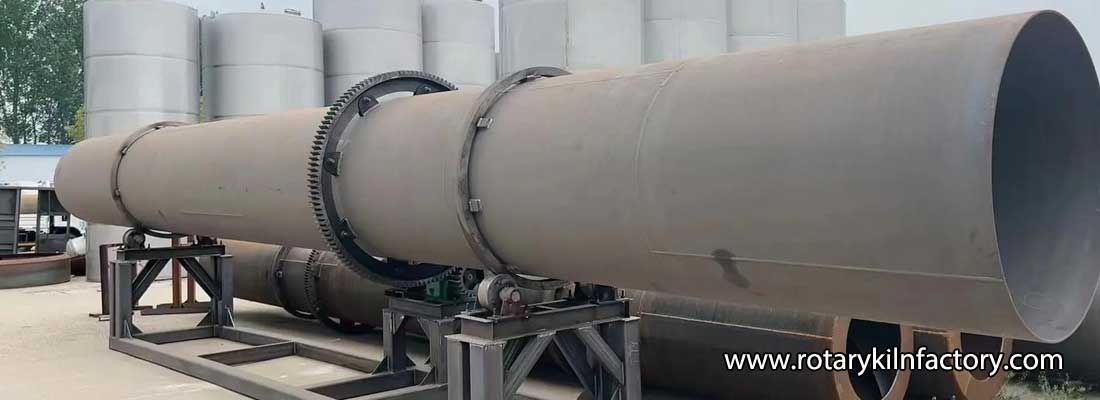

Dry process cement kiln is a kind of rotary kiln which is mainly used in calcining cement clinker. The cement clinker made by the dry process has better quality and stability. It can bring more economical and social benefits in production.

The Different Between Dry Process And Wet Process
Dry Process
Dry process method means manufacturing raw materials into raw materials powder, whose water content is generally less than 1%. So, the dry process can `reduces heat loss needed by heating and autoclaving water. But the dry process has its own flaw that is the bad fluidity of materials grain in a kiln. It will cause an uneven mix.
Wet Process
The wet process method is manufacturing raw materials slurry with 32%-40% water content. Wet process method’s advantage is that its good fluidity of raw materials slurry makes more even mixed materials and produces high-quality clinker. But it requires more heat consumption, so it is environment-friendly.

Dry Process Method’s Advantages
- The dry process has an excellent pre-warm system, which can speed up the rotation of kiln in operation to raise the yield.
- The dry process has a good stealing system. It can take full advantage of waste heat to lower the running expenditure.
- The dry process has a great adaptation to materials. So the device runs steadily. Cement clinker calcinated in the kiln has better quality, which brings more economic benefits for enterprises.
- Dry process owns the perfect dust removal effect, it decreases the quantity of dust in operation which improves the operational environment and makes environmental protection more convenient and faster.

New Dry Process Cement Production
New dry process cement production keeps new dry process cement production technology as the core. It adopts new materials, pre-homogenization technology and energy-saving milling technology and device. New dry process cement production uses all fronts computer distribute control system to achieve automation, efficiency, good quality, low energy consumption and environment-friendly.
The key symbol of new dry process cement production technology is that it adopts a new dry process cement kiln(general name for suspended pre-warm machine and predecomposition kiln). New dry process cement production kiln is the upgrading kiln type for old dry process cement kiln(also called dry hollow kiln). New dry process cement production technology is superior to shaft kiln, dry hollow kiln, vertical Bohr kiln and wet process cement production in thermal efficiency, parts and materials consumption like refractory bricks, enlargement, and quality of clinker.

New dry process cement production technology developments in the 1950s. So far, developed countries like Japan and German adopt a new dry process cement production device, which takes suspended pre-warm and pre-decomposition as the core, more than 95%. Chinese first new dry cement production kiln goes into operation in the year of 1976. The development stages of new dry process cement production: The first stage, the 1950s-1970s, newborn and development stage of suspended pre-warm; The second stage, the beginning of the 1970s, newborn and development stage of pre-decomposition.
Dry process cement production kiln is the typical kiln type during the end of the 18th century and the beginning of the 19th century. It is a big step for haft kiln. Because of its less than 1% water content dust raw materials, it reduces the most needed heat for evaporating water. So, it needs less time than wet process cement production. But old dry hollow kiln doesn’t have a waste heat utilization device, the temperature of the kiln tail is normally 700-950 degrees centigrade. Some factories may see the scenery of the blazing chimney, which is a serious waste of thermal energy. The thermal energy consumption of dry hollow kiln per kg can reach up to 1713-1828kcal. And it produces lots of dust; pollutes severely; produces production with bad raw material homogenization, terrible quality, and less quantity. Considering the above characters, it is not hard for us to imagine that dry hollow kiln is replaced by wet process cement production kiln for a while. At the beginning of the 1930s, vertical Bohr kiln appeared. It installed great heater in the tail, heating raw materials balls with 12%-14% water content, which takes good advantage of waste heat. The temperature of the kiln tail drops to 100 degree centigrade-150 degree centigrade from 700-degree centigrade.
While the thermal energy consumption widely dropped, the yield and quality sharply increased. In the 1950s, cyclone preheater kiln came out, which made well use of waste heat in kiln tail. Especially, when the beginning years of the 1970s, a new kiln production line with kiln decomposition furnace pushed the dry process to a new stage.
This kind of kiln with low energy consumption, high yield, good quality, and new technology has become a new direction for national wide cement production.
New Dry process Cement Method Technological Process
- Crushing and pre-homogenizing.
- Raw materials preparation.
- Raw material homogenization.
- Preheat decomposition.
(1) Material dispersion (2) Gas-solid separation (3) pre-decomposition - Firing of cement clinker.
- Cement milling.
- Cement packaging.